-
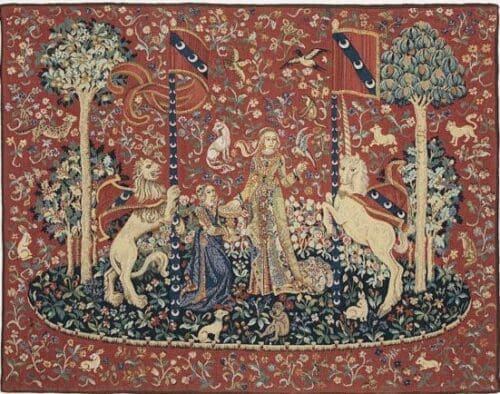 Lady with the Unicorn is an adaptation from the original Unicorn Tapestries which are devoted to each of the human senses. This series is undoubtably the most celebrated medieval group of tapestries in the world. The wonderful shades of blues and reds, along with the Mille-Fleurs background design, impart a rich mood very much like the originals. Lady with the Unicorn- Taste represents the sense of "taste" as a lovely woman is tasting the delicacies offered her by a handmaiden with a unicorn and a lion at her sides. According to legend, only fair and virtuous maidens could approach the otherwise elusive unicorn, symbol of purity. The lion, symbol of strength, is also at the maiden's side.
-
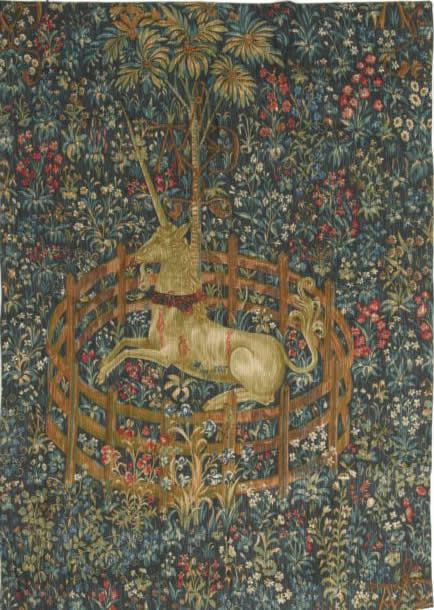 Adapted from the 15th Century original now in The Metropolitan Museum of Art in New York, The Unicorn is an age-old symbol of purity.
-
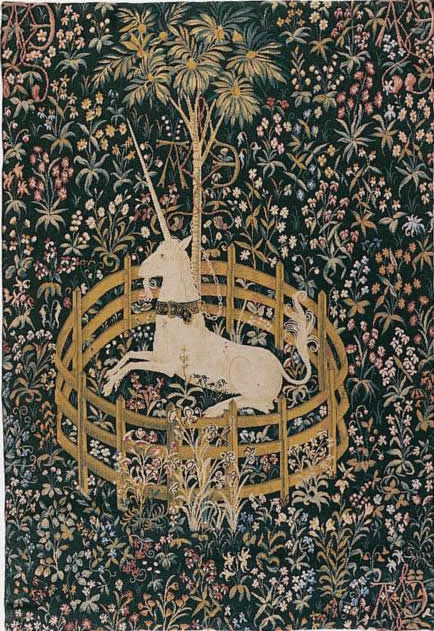 An age-old symbol of enchanting beauty and purity, the unicorn is a classic and recurring element in tapestries. The 15th century original Unicorn in Captivity is in the Metropolitan Museum of Art in New York.
-
 Lady with the Unicorn is an adaptation from the original Unicorn Tapestries which are devoted to each of the human senses. This series is undoubtably the most celebrated medieval group of tapestries in the world. The wonderful shades of blues and reds, along with the Mille-Fleurs background design, impart a rich mood, very much like the originals.
-
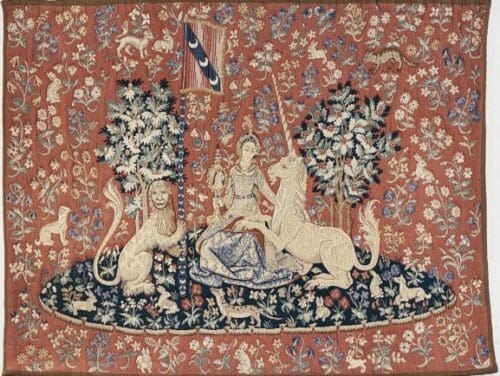 Lady with the Unicorn is an adaptation from the original Unicorn. This series is undoubtably the most celebrated medieval group of tapestries in the world. The wonderful shades of blues and reds, along with the Mille-Fleurs background design, impart a rich mood very much like the originals. Lady with the Unicorn- Sight represents the sense of "sight" as a maiden offers a mirror to the unicorn whose image is reflected in it. The detail of the mirror is particularly noteworthy.
-
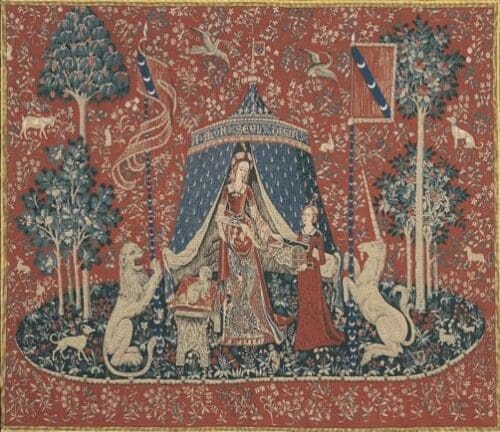 To My Only Desire presents a richly clad lady standing in front of a tent crowned by a banner on which is inscribed "a mon seul desir" (to my only desire). In Lady with the Organ, the organ and its music represent the sense of "hearing". The lion and the unicorn, emblems of strength and purity are both raising banners to represent their unity. Both tapestries here are superb adaptations from the originals now in the Cluny Museum in Paris. The original series of six tapestries were presented to Claude de Viste by Jean de Chabanne as an engagement present in 1512. the first five tapestries are devoted to the senses, while the sixth, "To My Only Desire" probably represents love.
-
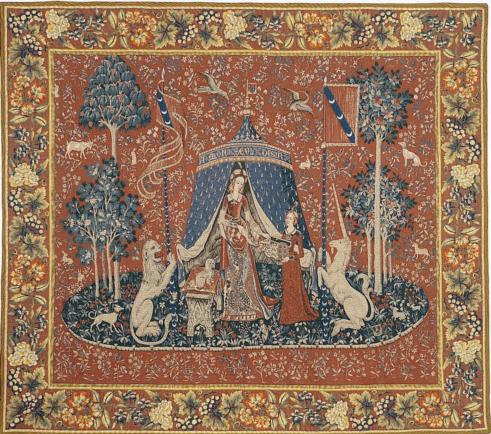 A noble lady stands in front of a tent crowned by a banner on which is inscribed "a mon seul desir" (to my only desire).
-
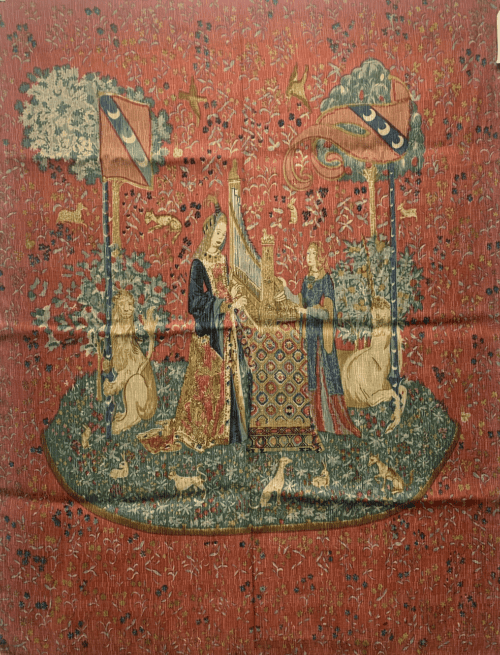
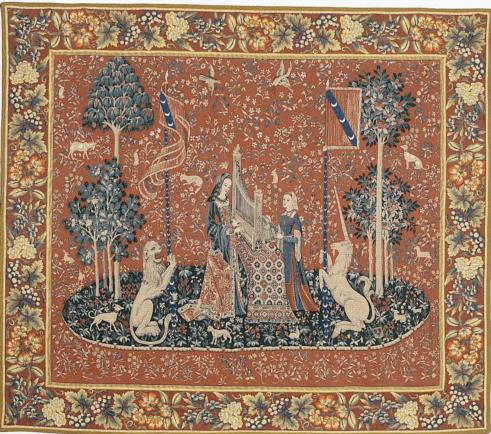 Organ, the organ and it's music represent the sense of "hearing." The lion and the unicorn, emblems of strength and purity, are both raising banners to represent their unity. Both tapestries here are superb adaptations from the originals now in the Cluny Museum in Paris. The original series of six tapestries were presented to Claude de Viste by Jean de Chabanne as an engagement present in 1512.
-
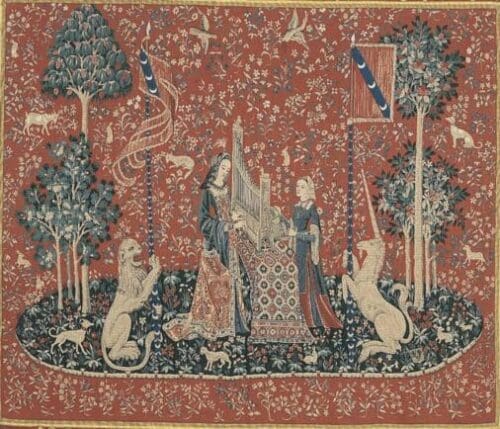 To My Only Desire presents a richly clad lady standing in front of a tent crowned by a banner on which is inscribed "a mon seul desir" (to my only desire). In Lady with the Organ, the organ and its music represent the sense of "hearing". The lion and the unicorn, emblems of strength and purity are both raising banners to represent their unity. Both tapestries here are superb adaptations from the originals now in the Cluny Museum in Paris. The original series of six tapestries were presented to Claude de Viste by Jean de Chabanne as an engagement present in 1512. the first five tapestries are devoted to the senses, while the sixth, "To My Only Desire" probably represents love.
Customer Service Hours
Monday – Friday: 9 AM – 3 PM
Phone
(312) 622-8130
If we’re unable to answer your call, please leave us a message, and we’ll return your call as soon as possible.
© Copyright 2026 | PIR Vintage Tapestries | Web Design by Sera Group